
Florida Republican targets local and state government unions at behest of anti-union group
Emails obtained through a public records request show Florida GOP Sen. Jonathan Martin was urged by a lobbyist with an anti-union group to file legislation targeting public sector unions.


Caring Class Revolt is a 100% reader-supported publication. And full disclosure, it’s a side project of mine that I work on outside of my full-time job as a local news reporter. I launched this Substack because I care about documenting news affecting Florida’s labor movement that otherwise goes under- or unreported. If you appreciate posts like this, please consider becoming a free or paid subscriber and/or sharing this publication with others.
Highlights of this story:
Anti-union legislation proposed by Florida lawmakers could make it easier for the state to get rid of local and state government unions.
The legislation is backed by anti-union groups that have a working relationship with Gov. Ron DeSantis.
The legislation builds on a law passed by lawmakers in 2023 (SB 256) that has already dissolved more than 120 unions across the state, plus has proved costly for both unions and taxpayers.
The House version (HB 995) of this new legislation is scheduled for its first committee hearing by lawmakers on Thursday.
Legislation first unveiled publicly last year that would make it easier for the state to dissolve local and state government unions, plus scare off any public employee strikes, has resurfaced this year after failing to pass during Florida’s 2025 legislative session.
If passed, the legislation (HB 995/SB 1296) would require a majority of workers in a bargaining unit (a group of members represented by a union) to vote in favor of unionization during a union election in order to prevail, instead of just a majority of those who vote — essentially making it harder to form a union or retain an existing union.
It would also get rid of a key pathway towards forming a union in the first place for local and state government workers — a process known as voluntary union recognition — and increase the financial penalties for unlawful strikes by public employee unions. Public sector strikes are already barred under state law and the state Constitution, as it is.
Under the proposal, unions could face up to $120,000 in daily fines for unlawful strikes (up from $20,000 per day, max), while “officers, agents, or representatives” of the union themselves could face additional daily fines ranging from $300 to $600.
I wrote about this anti-union legislation last year and the billionaire-backed think tank known as the Freedom Foundation that helped draft the proposal behind the scenes, according to email communications and documents I obtained through various public records requests filed in 2024 and 2025.
Records I obtained from the Florida House and Senate show this drafting occurred in collaboration with the Governor’s office and the state Public Employees Relations Commission, a small state agency tasked with enforcing public sector labor law.
The proposal, however, failed to advance far last year amid a bout of infighting among the GOP within the Florida Legislature. The House version (HB 1387), sponsored by Rep. Jenna Persons-Mulicka, cleared just one committee in a 10-7 vote last spring before being laid to rest, while the Senate version (SB 1328) failed to secure a single committee hearing (after being scheduled for a couple of hearings, the bill ultimately was “not considered” according to Senate records).
Part of the problem was that, on the Senate side, the bill was sponsored by then-Sen. Randy Fine, a Republican culture-war hawk who resigned from the Florida Senate last year in order to run for U.S. Congress. Another version of the bill (SB 1766) was sponsored by then-Sen. Blaise Ignoglia, a Republican who also left the state Senate last summer, post-session, after being appointed by Gov. DeSantis to serve as the state’s Chief Financial Officer.
State senators, including the few Republicans who voted against the state’s biggest attack on unions in decades in 2023 (Senate Bill 256), also just didn’t seem to have the appetite for advancing anti-union bullies’ interests last year amid state budget battles, a scandal involving the Hope Florida charity affiliated with DeSantis’ wife Casey, and tension between House and Senate leadership.
But that hasn’t stopped some Republicans from refiling the anti-union proposal for consideration this year. And there’s a paper trail for how we got here.
Emails I obtained through a public records request last year, for instance, show a lobbyist for the Freedom Foundation — one of the conservative think-tanks behind Senate Bill 256 — emailed Republican Sen. Jonathan Martin’s office last April, asking if Martin would be willing to sponsor legislation formerly carried by Fine.
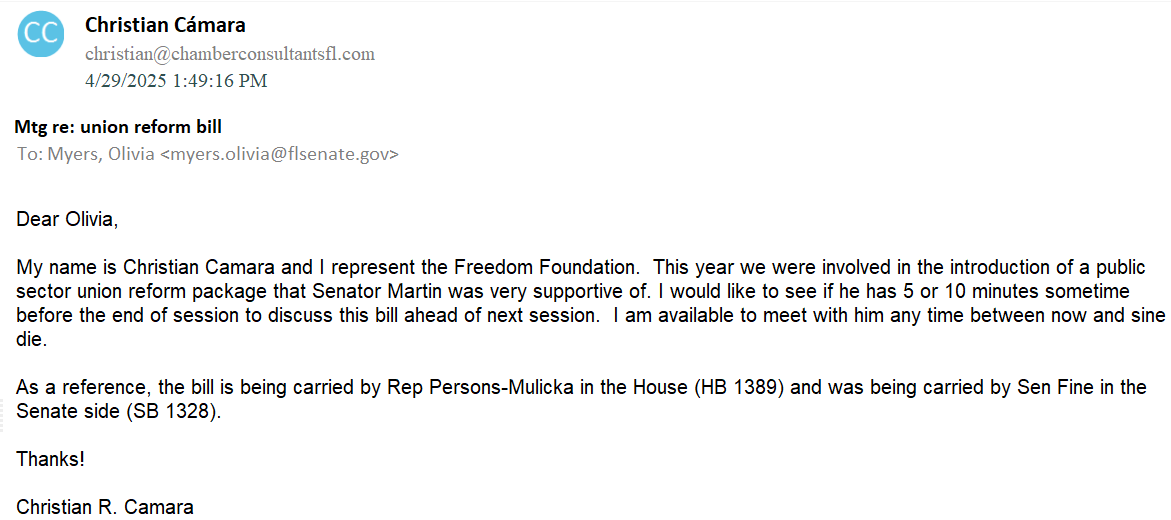
“My name is Christian Camara and I represent the Freedom Foundation,” Camara, a lobbyist with Chamber Consultants LLC, wrote in an introductory email to Martin’s legislative aide on April 29, 2025, about a month after Camara similarly appealed to Sen. McClain, who “respectfully declined” the Freedom Foundation’s request for him to cosponsor their bill.
“This year we were involved in the introduction of a public sector union reform package that Senator Martin was very supportive of,” Camara wrote to Martin’s aide. “I would like to see if he has 5 or 10 minutes sometime before the end of session to discuss this bill ahead of next session.”
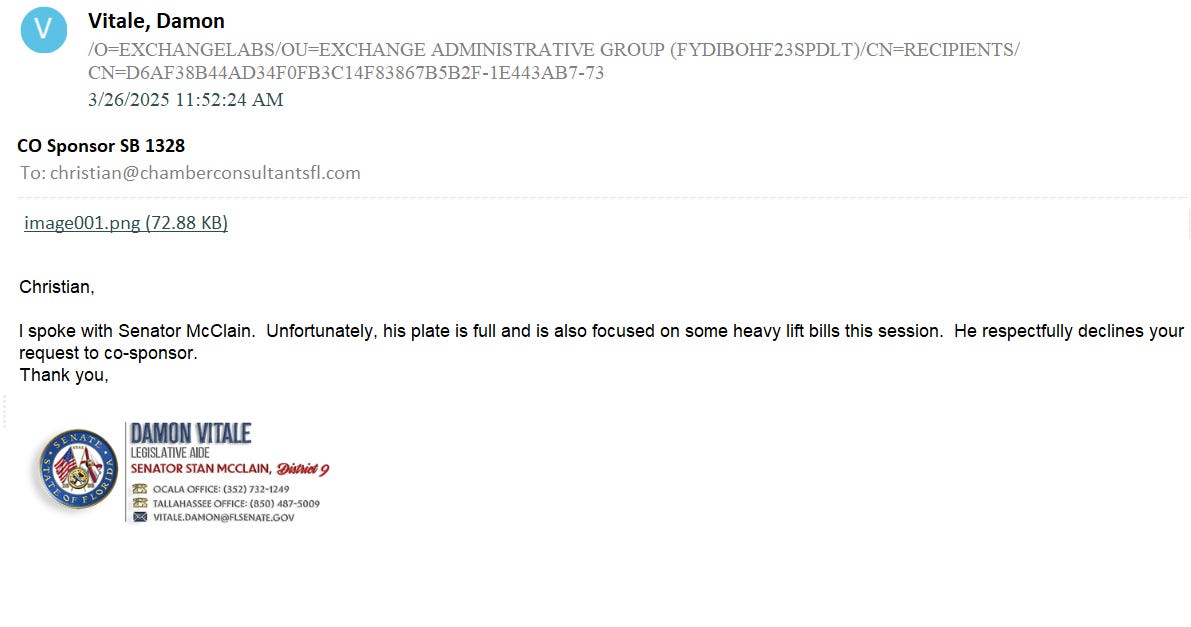
Martin’s aide initially responded sharing that the senator didn’t have time for a meeting to discuss the proposal. But we can gather (if not ascertain) from this communication that the Freedom Foundation forged a connection with Martin, regardless — one that appears to have resulted in the senator’s willingness to carry their proposal this year.
I emailed Martin’s office several times to seek comment from the senator on his decision to file the legislation this session, his office’s communication with the Freedom Foundation, and what he actually hopes to accomplish with the bill. His legislative aide initially responded to my inquiry several days past my deadline, apologized for doing so, and did not accept my offer for her to share a statement anyway, even past deadline, so I could include that for readers’ understanding of the situation.
I haven’t received any follow-up since (Reader, I tried).
If the legislation does get scheduled for a hearing this year, however — that’s never guaranteed — we’ll get the chance to hear that explanation from him then.
It’s unclear to me at this point whether this proposal really has legs this year. Republicans and Democrats alike claim their priority is affordability (while also advancing state preemption legislation and bills targeting people who seek abortion care and healthcare providers who “aid and abet” transgender minors in receiving gender-affirming care).
But the House version of this proposal (House Bill 995) just got scheduled for its first hearing by a House subcommittee this Thursday. So it’s worth keeping an eye on.
Building on past reforms
The proposal, first drafted as a rough sketch for lawmakers’ consideration in 2024, would ultimately build on Senate Bill 256, which was backed by the majority of Florida’s Republican-dominated Legislature in 2023, with Democrats in opposition.
That legislation, gleefully signed into law by Gov. Ron DeSantis, forces public sector unions in Florida (with the exception of police and firefighter unions) to undergo annual elections in order to stay certified if the percentage of workers in the union who pay dues is less than 60% of the total workers in the bargaining unit. If a union fails to file a petition for a recertification election, or if a majority of workers vote to get rid of their union in that election, then the union is decertified, or effectively dissolved.
The cost of these new, annual elections is split between the public employer (i.e. taxpayers) and the union, and budget proposals from the state agency tasked with conducting them — the Public Employees Relations Commission — show the law has significantly overburdened their under-prepared office.
“Since SB 256 passed in 2023, the Public Employees Relations Commission (PERC) has experienced a surge in workload across all areas,” the agency wrote in its budget request for the 2026-27 fiscal year. Senate Bill 256, they explain, caused their caseload to nearly triple, from 329 cases in the 2022-23 fiscal year to 855 in 2024.
Because of the new recertification election requirements, the law also caused the number of union elections they conduct annually to increase from 20 elections in fiscal year 2022-23 to 250 projected elections in the 2025-26 fiscal year.
“This has overwhelmed staff, causing delays of up to a year in processing recertifications and elections,” the agency notes in its budget request, asking for an extra $835,018 in state funds this next year to hire six new staff members. “These positions are needed to ensure timely processing of cases, registrations, and elections in order to hold unions accountable,” the agency claims.


Turns out union-busting is costly, but if you read Caring Class Revolt’s bimonthly union-buster roundups, you know that already.
Organized labor knows it, too.
“DeSantis demands 835K because his failed efforts to break public employee unions have created staffing headaches at PERC,” the University of Florida’s United Faculty of Florida chapter, representing full-time faculty, wrote in response to a post I published about this funding request on X. “Union busting is an expensive flop — and now he wants the public to foot the bill!!!”


Indeed, PERC’s budget has increased from $3.69M in FY 2022-23 to roughly $6 million in this current fiscal year’s budget, according to budget documents. The agency’s latest proposal for FY 2026-27 would boost this to $7.75M if approved by the Florida legislature and Gov. DeSantis.
Beyond the financial cost, I’ve tracked more than 120 bargaining units across the state that have been decertified since Senate Bill 256 took effect, affecting more than 69,000 local and state government workers across the state.
Effectively, this means tens of thousands of state and local government workers in Florida have not only lost their union representation, but also the union contracts covering their jobs that included things such as guaranteed workplace safety protections, wage increases, and other job benefits that they are no longer entitled to without their contracts.
Blue-collar workers at the University of South Florida, such as maintenance employees, even saw their jobs privatized after the dissolution of their union, without having any say in the matter.
Most of the state’s teachers unions — the primary target of Senate Bill 256— have nonetheless managed to mobilize, organize, and survive the law’s new stringent requirements for public employee unions, in spite of Gov. DeSantis and his anti-union allies. At least nine former bargaining units of city and county employees — from utility workers in Lake Worth Beach to Jacksonville Housing Authority employees — have also either re-organized their unions, after seeing their union dissolved by the state, or are in the process of doing so.
“Educators in the state of Florida, whether it’s professors or graduate assistants, whether it’s instructional staff in our K-12 schools or our support staff in those schools, they have all made it clear they want their union, and they want their contract,” Andrew Spar, president of the Florida Education Association, told me in an interview last year for Orlando Weekly.
Spar’s union, affiliated with the American Federation of Teachers and National Education Association, represents more than 120,000 teachers and school staff in K-12 schools statewide, plus thousands of full-time faculty and graduate student workers at public colleges and universities through the affiliated United Faculty of Florida and Graduate Assistants United.
It’s largely blue-collar workers and other white-collar employees (such as bus drivers, nurses, and attorneys) represented by unions like AFSCME, the Teamsters, and LiUNA that have seen their unions decertified in the wake of the Senate Bill 256’s passage. All of the state’s adjunct faculty unions, which first organized with the higher education arm of the Services Employees International Union (SEIU) through a flurry of organizing drives about a decade ago, have also been dissolved. In most cases, however, this is not because workers voted against keeping their union, but because union leadership didn’t file a petition for recertification and they didn’t get the chance to vote in the first place.
Nothing new
Efforts to undermine public sector unions through the Florida Legislature in recent years are the culmination of over a decade of collaboration between various right-wing organizations that oppose unions, including the Koch-affiliated Americans for Prosperity and the Freedom Foundation, an organization headquartered in Washington State that’s perhaps best known for sending misleading mailers to union members across the country, urging them to opt out of their union membership.
But unions are used to being a political punching bag in Florida. In the 1940’s, Florida became one of the first states in the country to pass a ‘right-to-work’ law rooted in racist efforts to dissuade multiracial organizing and undermine the power of Black workers. Right-to-work laws (not to be confused with “at will” employment) prohibit workers from being required to pay dues to unions, even if they are represented by a union and benefit from union representation.
A couple of decades later, a ban on strikes by public sector workers was also enshrined in Florida’s constitution, allowing workers to be fired or fined if they walk off the job. This didn’t, however, stop Florida teachers from staging the first statewide teachers’ strike in U.S. history in 1968 over familiar issues today such as low teacher pay and the under-funding of public schools.
Today, less than seven percent of workers in Florida are represented by a union, even though public support for unions is high and research shows union membership is associated with higher wages, better or stronger job benefits, and reducing racial and ethnic pay gaps.
Under the first Trump administration, the labor movement sustained several hits, from Trump stacking the National Labor Relations Board with unfriendly corporate-side lawyers to bringing on a professional “union avoidance” consultant (a.k.a union buster) as an advisor within the Department of Labor who later went on to lobby in favor of Senate Bill 256 in Florida on behalf of the Freedom Foundation.
So far in Trump’s second term, his administration has sought to end collective bargaining rights for hundreds of thousands of federal government employees, slash minimum wage protections for home healthcare workers, undermine workplace safety rules, and axe federal grants to fight child labor violations.
In Florida, state lawmakers this session will also be considering bills that aim to create a loophole in the state’s minimum wage requirements, make it harder to access unemployment benefits, and disincentivize public and private employers from voluntarily recognizing unions (similar to proposals introduced or passed in other red states).
I’ll keep you posted on what sticks.
Great reporting as always, thanks!
It's seriously infuriating that the people who make it their life's mission to destroy unions, minimum wage increases, workplace safety laws, and retirement benefits are also almost all disgustingly wealthy. Imagine being worth millions or billions and yet STILL going to immense efforts to steal even more money from the pockets of those who have the least.